CHURCHES
- Name of map document (appears in dropdown)
- CHURCHES
- Description to appear in introductory popup
-
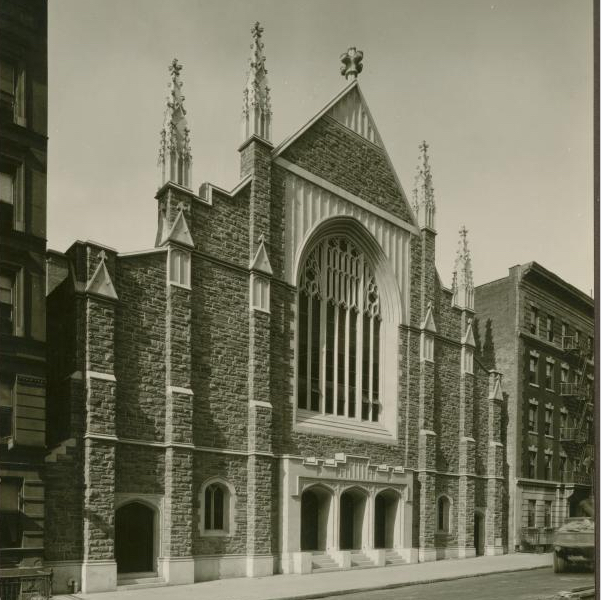
Churches were the most prominent black places and institutions in Harlem. They made a powerful impression on visitors to the neighborhood. This map shows the 52 black church buildings located in the neighborhood.
A number were elaborate, grand complexes, which coupled houses of worship with seating for over a thousand, with community houses, incorporating gyms, reading rooms, recreation rooms and offices. (On the map, those structures have large, distinctive footprints that suggest how they stood apart from the surrounding buildings). The buildings reflect the broad role Harlem's churches played in community life: they organized sports (particularly basketball teams), classes ranging from vocational training to art, musical groups, and social clubs.
Fourteen of the largest churches were purchased by black congregations, who were moving with their members from downtown, from white congregations (Christian and Jewish), whose members had left Harlem. These included Metropolitan Baptist on West 128th & 7th Avenue (which held 1500), Salem Methodist Episcopal on West 129th and 7th Avenue (which held 3000), St James Presbyterian Church on West 141st St, and Mount Calvary United Methodist on Edgecombe Avenue. Nine other relocating black congregations built their own grand churches, including St Philip's Episcopal on West 134th Street and the Abyssinian Baptist Church on West 138th St, which seated 3000. Other groups, such as Metropolitan AME and Union Baptist, converted residences or theatres.
Setting up in Harlem was often not the final move a congregation made. It was common to relocate within the neighborhood, seeking more space as membership grew. Thus while on first glance the map suggests Harlem's churches were spread throughout the neighborhood, by the late 1920s, most of the major houses of worship were located on or near 7th Avenue, or further west. That was where the churches built by white congregations were located. Only below 125th, where the black population did not predominate until 1930, were there major church buildings on Lenox Avenue and further east
Church buildings were not the only locations in which Harlemites worshiped. Missing from this map are the churches that operated in storefronts and residences, which far outnumbered those housed in church buildings. Writing in Opportunity magazine in 1926, ira Reid reported finding 140 churches in 150 blocks in Harlem; two thirds were located in storefronts. Unfortunately Reid does not provide locations for the 'house churches' he discusses, but one group, the spiritualist churches (which combine communication with the dead with elements of Christianity) do advertise in the black press. To add them to this map, do a 'Place' search for 'Location type' "Spiritualists".
For more on Harlem's churches, including photographs of some, see the related blog post
- Featured map or Individual
- Featured map 1915 - 1930
- Order
- 10
- Map layers
- Churches 1915-1930
- Bromley Real Estate Map
- Black Harlem 1920
- Black Harlem 1925
- Black Harlem 1930
- Map zoom bookmarks
- Harlem, -73.9800,-73.930000,40.79,40.83,1915,1930
- Western hemisphere,-90,0,-20,60,1915,1930
- Minimum zoom (km)
- 0.00005
- Maximum zoom (km)
- 10
- Show legend on startup
- Show legend on start
- Suppress timeline
- Automatic
- Media
-
 Church.jpg